Included in the Listening posters at Beyond Listening 2025: Walking-with Changes
Introduction
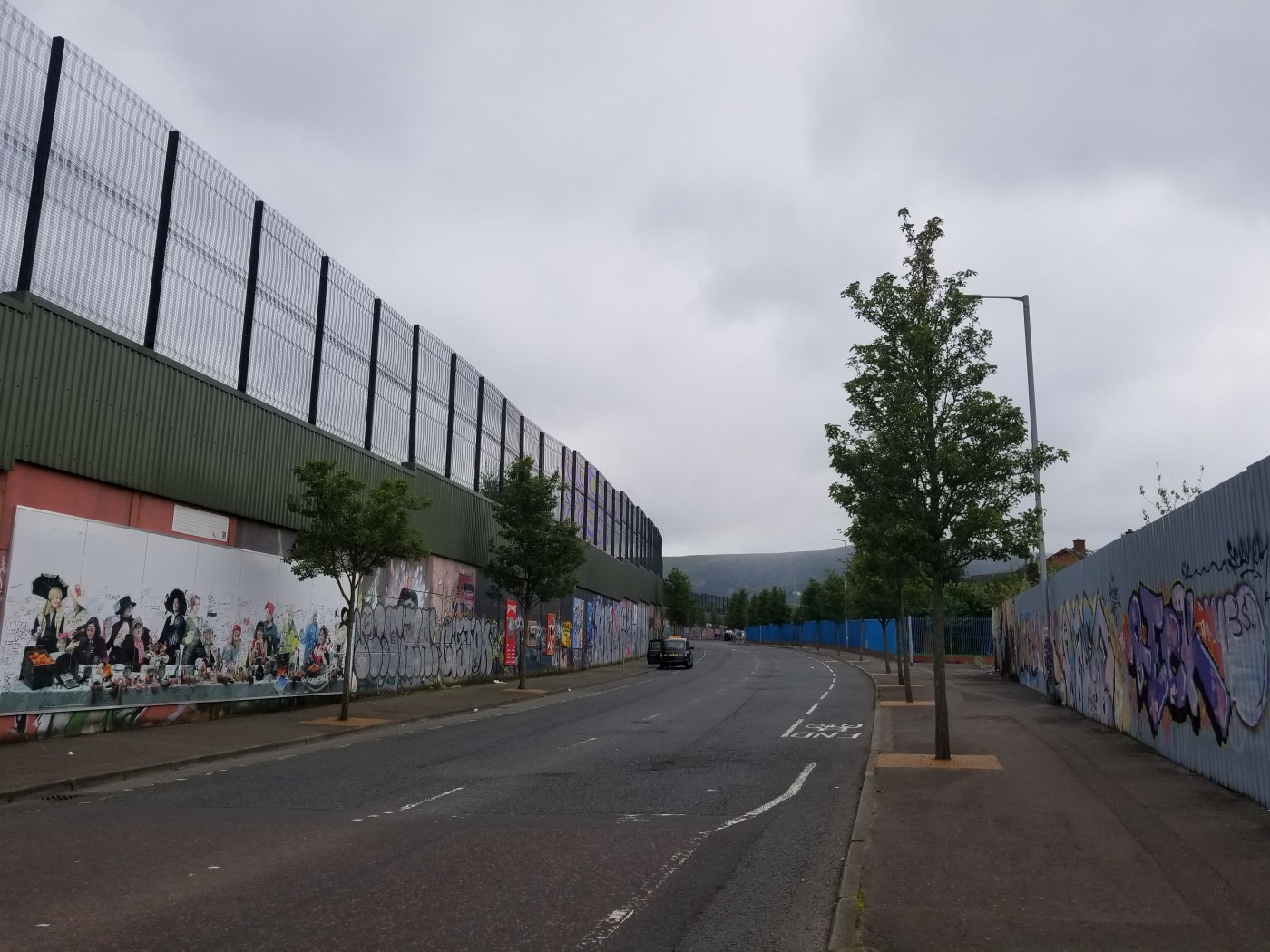
In West Belfast lays the Peace Wall Belfast, a manifestation of multifaced messages on political, religious, and communal ideals represented by physical properties of cement, metal, fences, gates, and artwork. There have been discussions on initiatives to take down the walls, however, this remains a fragile state. When thinking about the connectivity of the surrounding spaces and communities, the placing of the Peace Wall(s) blocks any opportunity of cross-communication and produces disorienting effects. However, through alternative artistic approaches focusing on sound, there can be innovative capabilities of sharing these stories and spaces with spatial audio techniques. To use spatial audio to change the perception of these spaces brings forth alternative periods of reflections from stimulating another sensory tool other than sight. Forming two unique listening experiences that focus on the virtual abilities to combine auditory spaces into an immersive installation environment and binaural soundwalks to design site-specific augmentation of the sonic properties of the Peace Wall’s surrounding spaces. These projects aim at using spatial audio and artistic practice to plan new approaches for conflict transformation in Northern Ireland.
Read more here:
Varoutsos, G., 2020. Peace Wall Belfast: Spatial audio representation of Divided Spaces and soundwalks, in: Proceedings of the 17th Sound and Music Computing Conference, Torino, June 24th – 26th 2020. Presented at the Sound and Music Computing Conference (SMC 2020), Zenodo, pp. 123–130. https://doi.org/10.5281/zenodo.3898717
1. Divided Spaces – Project Information
This research project focused on storytelling from interviews and BBC Northern Ireland archival material with the combination of various recording methods to create an audio immersive installation. In specific, it is to highlight the connectivity of spaces and experiences through sound to highlight past, present, and future relations with the Peace Wall Belfast. The foundation of the project rested on the spatial audio concept of ambisonics to have the piece distributed for different listening environments.
| Section: | Time code: |
| Introduction | 00:00 – 01:31 |
| Past | 01:32 – 06:17 |
| Present | 06:28 – 20:09 |
| Within Present – Peace Wall | 12:50 – 16:06 |
| Within Present – Sound Wall | 16:07 – 20:09 |
| Future | 20:10 – 22:13 |
Sections split in time frames
The research reflects on the experiences with Peace Walls and history of the ‘Troubles’, this undoubtedly provokes sensitivity towards sharing experiences and therefore was hard to obtain numerous participants. Consequently, this shaped the focus from the gathered interviews and archival material to maintain an anonymous and neutral viewpoint. This means that there are no names, occupations, religious, political, or background of an individual exposed throughout any of the audio. There is neither any personal intention to promote either community from the Falls or Shankill.
The project composition and workflow instilled new methods of using ambisonics audio for creating separated sonic fields. Ambisonics allows for the capturing of multiple sonic fields (360° audio) and with SSA Plugins (Decoder and Panner) provide an ability to achieve a new effect by repurposing these sound fields into 90° positions and creating additional mixed 360° sound fields within the installation. This decoding and panning method led to an immersive space having capabilities of experiencing sonic division, as if the listener(s) took the position of the Peace Wall. Within the piece, sometimes the listener is exposed to either side of the wall, both of sides of the wall together, and even a mixture of separated/joined spaces.
Examples in Divided Spaces:
| Listening: | Time code: |
| Either side of the wall | 06:48 – 08:00 / 09:44 – 10:32 |
| Both sides together | 15:07 – 16:08 |
| Mixture of separated/joined spaces | 10:40 – 11:44 |
Types of ‘listenings’ exhibited in the piece
This is visually portrayed as:

Listening Environment
Combining an array of audio material (ambisonics, stereo, mono sources), into a multi-layered and segmental sonic field shifted the original concepts from an audio piece into an installation. The ability to take traditional concepts of ambisonics and use it in forms that can compress several large physical areas into an audio immersive installation assisted in the idea of simultaneously listening to both sides of the wall. The installation encourages for a listener(s) to walk through, around, and be virtually present between the two sides. It also supports the ability to embody the perceptions to and from the Peace Wall. This results in inspiring listener mobility to cross into either of the auditory spaces with their own free choice and therefore generates a unique sonic experience for that listener(s).
Piece #1 – Divided Spaces
Programme Note:
Divided Spaces | (22min32s)
Divided Spaces aims to showcase the experiences of individuals living near Peace Walls in West Belfast and explore the history of the Troubles. The project employs various storytelling methods, including interviews, field recordings, and archival materials, to produce works in spatial audio formats. The project focuses on the role of sound as a tool for conflict transformation and peace resolution, considering shared stories, the connectivity of places and spaces, and how sound can foster relationships between the past, present, and future, particularly in relation to conflict and the Peace Walls. The listener is positioned between and on the wall, hearing the communities’ separation and potential future joining.
Audio (Binaural – wear headphones) Only:
Audio (Binaural – wear headphones) + Images:
2. Peace Wall Belfast Soundwalks – Project Information
According to CAIN: “Peacelines, or peace walls, are physical barriers between the Protestant / Loyalist community and the Catholic / Nationalist community in certain areas in Northern Ireland. The walls are usually constructed of concrete, stone, and / or steel, and can be over 6 metres tall. The ‘official’ peacelines grew out of barricades that the local communities erected themselves during periods of intense conflict in 1969 (and in later years). When the British Army was deployed in August 1969 it replaced the existing barricades with barbed-wire barriers of its own. It had been hoped that these would only be needed temporarily. However, the barbed-wire barriers were replaced with more permanent structures and over the years new peace walls have been erected and older ones extended in length and height. The peacelines represent the most visible form of the ‘sectarian interfaces’ between the two main communities in Northern Ireland.” (Ulsteracuk, 2019)
Piece #2 – Peace Wall Belfast Soundwalks
Peace Wall Belfast Soundwalks | 6 pieces ~1hr15min
Programme Note:
Peace Wall Belfast Soundwalks by Georgios Varoutsos is a binaural immersive experience with six soundscapes composed to highlight relationships between realism and perception. These are based on different sonic markers or events occurring in the areas of the Peace Wall Belfast, in Northern Ireland. The intention is to engage with specific areas around the wall to encourage new understandings, as well documents perception of sounds usually overlooked.
Ultimately, these soundscapes question how we listen to what we’re seeing, and what we’re seeing is it being heard?

St. Gall’s Ave (bottom)
St. Gall’s Ave -Bombay St (Green field)
Bombay St – Kashmir Rd
Cupar Way – Lawnbrook Ave
Cupar Way (middle)
Cupar Way – Conway St
***If in Belfast:
This project is now accessible via Echoes (GPS soundwalks – Available on the Apple Store and Google Playstore):
https://explore.echoes.xyz/collections/0txhFuJvg1KSjjHZ
Download or Stream the Soundwalk

The project was first conceived in 2019, as part of my Masters in Research (MRes) final project for the Sonic Arts Research Centre (SARC) at Queen’s University Belfast.
3. Ardoyne Peace Wall – Perspective Listening – Project Information
Building on my prior work with the Peace Walls and various recording techniques for diverse projects, I was invited in June 2022, along with my supervisor Professor Pedro Rebelo, to conduct field recordings around the Ardoyne Peace Wall. These sounds were collected for Annea Lockwood to incorporate into her score and composition for Maria Fusco’s experimental feminist opera-film “History of the Present”, which premiered on 19.04.23 for the Belfast International Arts Festival [part of the official programme for 25th anniversary commemoration of The Good Friday Agreement] and returned to Belfast for a showcase at the Golden Thread Gallery in February-March 2025.
In October 2022, the entire team, including Annea Lockwood, gathered to record additional sounds and demonstrate our process with the interface. Referencing my 2019 work, I explained how I used different microphones to capture, activate, and listen to the wall. Annea, Pedro, and I took turns recording and listening, sparking deeper discussions about what is perceived and what remains unseen, as well as how we experience these layers physically and socially, reflecting division through walls and infrastructure.
From this collection of field and sound recordings, I aimed to explore multi-perspective listening. Specifically, how shifting between microphones can emphasise tensions, alienation, and conflict through diverse listening modes.
Piece #3 – Ardoyne Peace Wall-Perspective Listening
Programme Note:
We often focus on the surface of tension and conflict. This piece uses experimental microphones to listen within the Peace Wall to begin revealing deeper issues. It shifts listening positions from everyday life and environmental sounds to the vibrations and tensions within the Wall caused by gestures and actions. By exploring these reactive sounds, the work offers a new perspective on sensitive topics, emphasising the layers within every conversation.
Audio (Stereo – wear headphones) Only:
Audio (Stereo – wear headphones) + Images:
4. Final Words
Currently, I am expanding the journey I began in 2018, which involves frequent visits, work, and exploration of the Peace Walls or similar interfaces through writings, publications, compositions, soundwalks, and solo or group visits. This ongoing conversation has deeply connected much of my work in Belfast through this line of research and creative practice.
I am always interested in fostering dialogue between individuals and groups, and I aim to broaden our understanding of how we listen to and connect with our environment.
Feel free to share the message and link with anyone who may be interested or would like to contact me here.
Thank you for taking the time to visit this page.
 Georgios Varoutsos